CC.NEWS Toronto, November 6, 2026
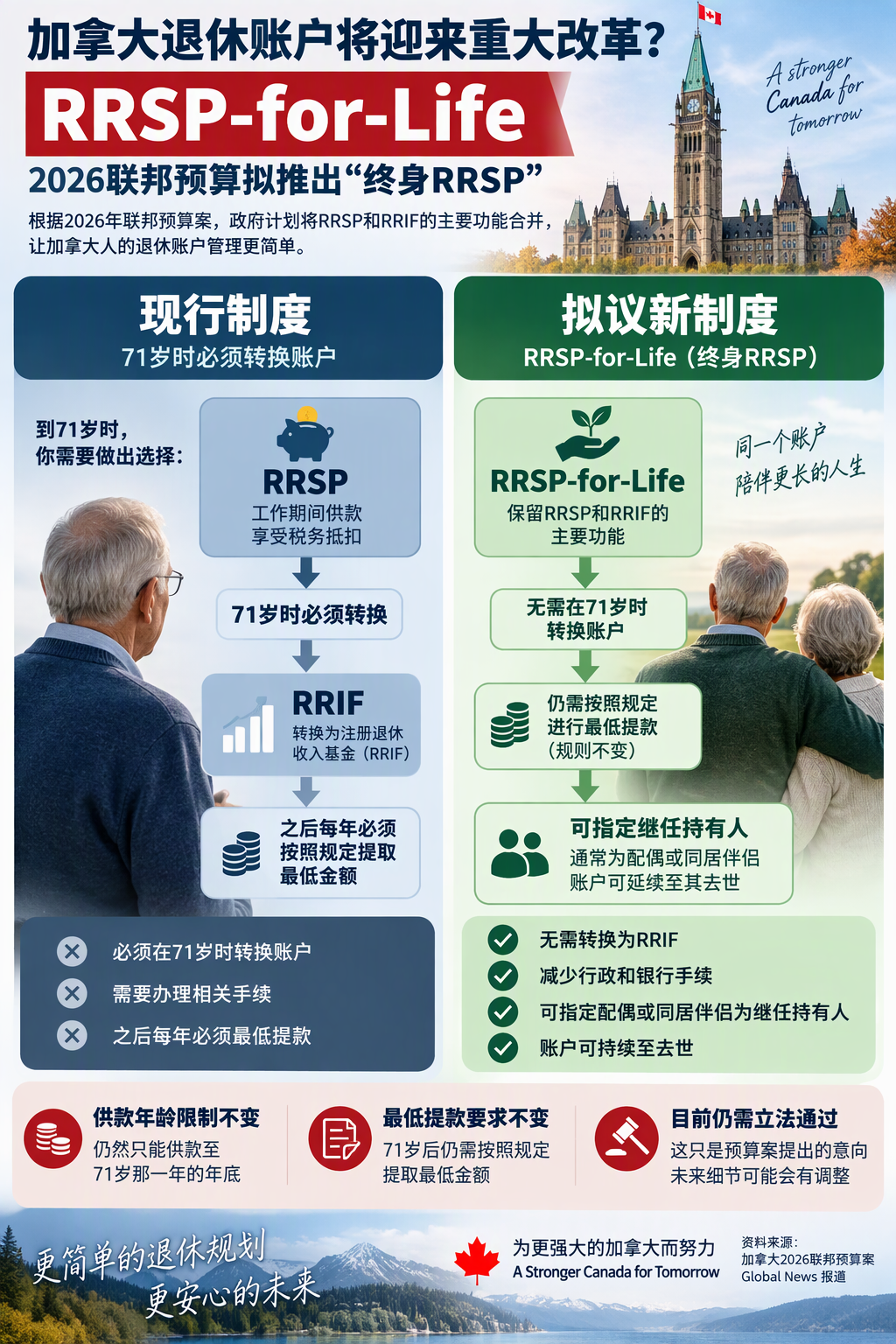
In its 2026 budget, the federal government has proposed a closely watched retirement reform: an “RRSP-for-Life” system. The biggest change is that Canadians may no longer have to convert their RRSP into an RRIF at age 71, and could instead keep the same retirement account until the end of their lives.
People in the industry see the proposal as one of the most important simplifications of Canada’s retirement income system in recent years, but for ordinary savers, many existing rules will not change.
How does the current system work?
At present, Canadians’ retirement savings generally go through two stages.
During their working years, residents can contribute to an RRSP (Registered Retirement Savings Plan) and receive the corresponding tax deduction.
When the account holder turns 71, they must choose from three options:
- Withdraw the RRSP assets in a lump sum and pay income tax;
- Purchase a retirement annuity;
- Convert the RRSP into an RRIF (Registered Retirement Income Fund).
For the vast majority of Canadians, converting to an RRIF is the most common approach. After the conversion, the account holder must withdraw a minimum amount each year as retirement income under Canada’s tax rules.
What will change under the new system?
According to the 2026 budget documents, the federal government plans to merge the core functions of the RRSP and the RRIF into a single “RRSP-for-Life” system. [
If the reform is ultimately passed into law:
- There will be no need to convert an RRSP into an RRIF at age 71;
- The retirement account can be kept as a single account;
- Administrative procedures at banks and financial institutions will be greatly simplified;
- Holders can maintain the same retirement account structure for life.
Tax experts say the reform is more a structural and administrative simplification than a new tax break.
Are withdrawals still required after 71?
The answer is yes.
Although the budget proposes eliminating the RRIF as a separate account type, it does not eliminate the existing minimum withdrawal requirement. After turning 71, holders must still withdraw a minimum amount as required.
At the same time, the age limit for contributions will not change either.
Under both current and proposed rules, Canadian residents may still contribute to an RRSP only until the end of the year in which they turn 71.
In other words, the reform mainly changes the account structure and the way it is administered, not the retirement income withdrawal system itself.
What matters most for Chinese-Canadian families?
For many Chinese-Canadian families, the budget’s proposal on “successor holders” may be of greater practical significance.
At present, a TFSA allows a successor holder to be named, but RRSPs have no exactly equivalent arrangement. Under the new proposal, the RRSP-for-Life would in future allow a spouse or common-law partner to be named as successor holder.
The budget documents note that, in certain circumstances, the retirement account could be kept until the death of the surviving spouse, without the account value having to be included in taxable income immediately because the account holder died first.
People in the industry believe this will help simplify retirement asset transfer arrangements in some families.
Do I need to take action now?
Not yet.
It should be noted that the reform is still a policy proposal in the budget. It must still pass a budget implementation act and go through approval by the House of Commons and the Senate before it becomes law. The technical details and implementation measures may still be adjusted in future.
So neither people who already hold RRSPs nor retirees who have already entered the RRIF stage need to adjust their personal retirement plans immediately because of this proposal.
In one sentence
If “RRSP-for-Life” is ultimately approved, managing a retirement account in Canada will become simpler: there will be no more RRSP-to-RRIF conversion after age 71, but core rules such as minimum withdrawals and the contribution age limit will remain unchanged for the time being.
Source: 2026 federal budget